
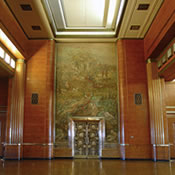
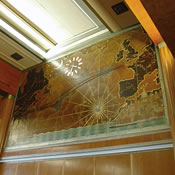

Preliminary design calculations looked at modern ship building techniques and all manner of parameters, married to Cunard's operating requirements and required service speed. Cunard calculated that the new liners would over 1,000 feet long, with a 80,000 gross tonnage. For the first of the liners, Cunard decided she would be driven by four steam turbine engines, split between a forward and aft engine room. These would turn four propellers, enough to provide a service speed of 28 knots. Steam would be fed to the turbines by 24 boilers, placed in five boiler rooms forwards and amidships. This number meant the ship would need three funnels to exhaust waste gases from the boilers. Accommodation would be for 776 cabin class, 784 tourist class and 579 third class, with 1,101 crew. The style of accommodation would differ greatly from previous Cunard ships. Their interiors had drawn heavily on English country house architecture, with Elizabethan, Jacobean and neo-Classical inspired designs. Instead, a new modern style influenced by the Art Deco style seen aboard the Ile de France was adopted, reflecting new found confidence in the modern age.